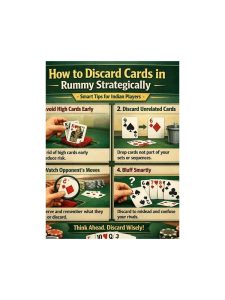
Rummy FAQ: Does Drawing From the Discard Always Reveal a Plan?
Drawing from the discard pile can reveal a clue about a player’s immediate need, but it does not always reveal a complete plan. A card may fit more than one sequence, repair a weak hand, or simply be safer than an unknown draw. Treat the action as one piece of information rather than a guaranteed explanation.
First, consider the card’s direct uses. A visible seven may connect two ranks in one suit, complete a pair, or protect a player from a high-point orphan. Without seeing the rest of the hand, you cannot know which reason applies. The same card can be attractive for entirely different arrangements.
Next, note the timing. Taking a discard early in a hand may indicate broad construction because the player is still exploring. Taking a discard late may indicate urgency, but it can also be a defensive choice that prevents an opponent from receiving a useful card. Timing changes the meaning, yet it does not remove uncertainty.
Use the information to improve your own decisions. If an opponent takes a card that you were considering, remove that exact card from your mental list of likely available improvements. Review nearby cards, but do not assume every neighbor is also wanted. A player may be building a set, a sequence, or something unrelated to your guess.
Avoid making a discard solely to test a theory. Deliberately offering a card because you think someone wants it can improve their hand and weaken yours. Your own hand should remain the main decision criterion. If two discards are equal for you, then opponent information can serve as a tie-breaker, but it should not replace your basic point and route review.
The useful question is not “What exact hand do they have?” It is “What possibilities should I update?” This keeps observation proportional to the evidence. Discard actions can help you narrow the field, but the strongest decisions still come from managing your own legal routes and risk.
Keep your observation notes modest. You might record that a player took a middle card or ignored a nearby card, but avoid building a fixed profile from one action. Different formats, hands, and turn positions produce different incentives. Information is useful when it changes your next review; it is noise when it merely creates a story you cannot test. Keep your own cards and legal requirements as the primary evidence throughout. This keeps observation useful without turning it into guesswork.