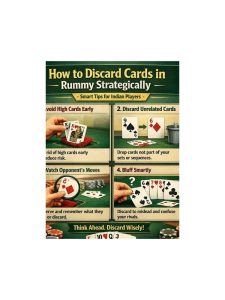
Rummy Joker Management: Keep Wild Cards Flexible
A joker can rescue a difficult rummy hand, but its value comes from flexibility rather than excitement. Many players place a joker into the first nearly complete group they see and then discover that a different use would have solved a larger problem. A simple management routine helps you keep the card useful while your hand develops.
Identify the urgent job
When you receive a joker, first inspect the hand without moving it. Look for a missing pure sequence, an incomplete group, and high-point cards that have no connection. In most Indian rummy formats, a joker cannot replace a card in a pure sequence, so it should not make you ignore that requirement. Your first question is therefore: what must be built without the joker?
If two natural cards already form a promising sequence, the joker may complete a second sequence or a group. If your hand has no realistic pure sequence, preserve natural cards that can create one and use the joker only for other structures. This prevents a common error: creating an attractive group while leaving the declaration invalid.
Compare flexibility, not appearance
Suppose you hold 6 and 8 of the same suit, plus a joker. Playing the joker as a 7 completes a sequence, but it may be more flexible to wait if another card could arrive naturally. By contrast, a joker that joins two isolated high cards may immediately reduce risk. Evaluate how many future draws each use supports. A card completing one fixed arrangement is less flexible than one that can serve several arrangements.
Recheck after every draw
Joker decisions are temporary. After drawing, re-sort the hand and ask whether a natural card now replaces the joker. If so, move the joker to a more valuable unfinished structure rather than treating the first arrangement as permanent. Keep the physical or on-screen layout clear so you can see which cards are natural and which are substituted.
Avoid overconfidence
A joker lowers the cost of some mistakes, but it does not guarantee a valid declaration. Before declaring, verify the required number of sequences, the pure-sequence rule, and the exact grouping. Use the joker where it solves a real constraint, then confirm that every remaining card belongs to a legal group. Flexible play is patient, visible, and supported by a final checklist.
One useful exercise is to deal a sample hand and write two possible joker placements before drawing. For each placement, list the natural cards still required and the high-point cards left loose. Then compare the plans after adding an imaginary draw. This shows why a joker should remain available when several routes are plausible. It also teaches you to distinguish a card that looks helpful from one that improves the complete hand. Keep practice free and low pressure; the goal is clearer evaluation, not faster or riskier play.