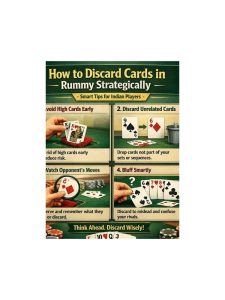
Rummy How-To: Build a Quiet Table-Reading Routine

Table reading does not require guessing another player’s exact hand. A quieter and more reliable routine is to notice public information, update it briefly, and return attention to your own decision. This keeps observation useful without turning every discard into a dramatic signal.
Choose three things to watch: cards repeatedly rejected, cards selected from the discard pile, and the pace of each player’s turns. The first two provide clues about possible priorities. The third can show when someone is taking extra time, but it is not proof of confidence or weakness. Treat all observations as evidence with limited strength.
At the beginning of your turn, look at the top of the discard pile and recall only the recent visible pattern. Ask whether the offered card improves your hand and whether taking it reveals useful information. If it does neither, draw from the stock or follow the format’s alternative. Do not collect every detail that you cannot use.
When discarding, consider what information your choice gives away. A discard that completes a common sequence may be more dangerous than a card that has little visible connection, but safety is contextual. You should not abandon a good move solely to appear unpredictable. Keep your own hand’s structure and scoring exposure as the primary priorities.
Use a simple confidence scale: strong, moderate, or weak. A repeated selection of the same suit is moderate evidence; one quick discard is weak evidence; several consistent choices over time may be stronger. Even strong public evidence can be incomplete, so phrase conclusions as “possibly useful to them,” not “they definitely need it.”
After the round, review one observation that helped and one that distracted you. If you spent time tracking information that never changed a decision, remove it from the routine. Good table reading is selective. It should sharpen a discard choice, not replace the basic work of sorting your cards and checking whether your hand can legally finish. Keep the routine silent and compact. You do not need to announce observations or explain them to other players. A private mental note such as “two selections from the same suit” is enough. Respect table etiquette and local rules about notes or devices. Observation should support fair play and your own concentration, never become a way to pressure another player or claim knowledge you do not possess. If you notice yourself collecting observations without using them, return to the three-item limit. The routine is successful when it improves one choice, such as declining a risky discard or recognizing a useful public card. It is not successful when it turns the round into a memory contest or causes you to overlook your own completion requirements.