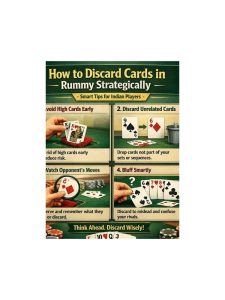
Rummy How-To: Run a Friendly Practice Round With Open Hands
An open-hand practice round is a useful bridge between explanation and normal competition. Everyone shows their cards, discusses possible melds, and focuses on process rather than winning. It should be treated as a structured lesson, not as a disguised competitive hand in which experienced players quietly optimize their own position.
Choose one learning goal before starting. You might practice identifying sequences, selecting a discard, or reading the discard pile. A single goal keeps the discussion manageable. Deal a normal hand and use the same turn order and drawing rules that the group will use later. If the practice round changes every rule at once, beginners may remember the conversation but not the actual game.
At the start of each turn, ask the active player to describe two possible plans. Other players can point out legal issues and ask what information supports each plan. Avoid immediately naming the best choice. The learner should compare flexibility, completion chances, points at risk, and what the discard communicates. Experienced players can model uncertainty by saying what they do not know.
Keep the revealed information organized. Do not allow players to touch another person’s cards, and return discarded cards to their correct position after discussion. If the group examines a hypothetical draw, place it beside the hand rather than mixing it into the deck. This preserves the sequence of events and prevents accidental claims about what was actually drawn.
End the round after everyone has had several turns, or finish it if the group remains attentive. Then ask each player to name one decision they would repeat and one they would reconsider. Compare strategies without ranking personalities. The goal is to show that a reasonable move can produce an unlucky result and that a lucky result does not automatically prove a good process.
After the review, play a normal closed-hand round. Remove coaching and use the agreed rules. The contrast helps learners discover which parts they understand independently. An open-hand session is most valuable when it creates better questions, not when it supplies a memorized line for every possible hand. n+Keep practice stakes low and the tone exploratory. If a learner tries an unusual discard, examine its consequences rather than laughing at it. Experienced players should mention when a preference depends on a variant or scoring system. Strategy is connected to rules, objectives, and information, not just a fixed list of moves. n+The teacher can rotate between players so one person does not dominate the discussion. Different explanations often reveal different learning needs, while rotating responsibility keeps the practice round collaborative and gives beginners confidence to speak.