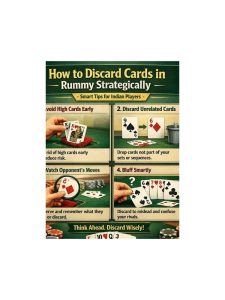
Rummy Tips: Compare Cards by Recovery Burden

A card can look promising and still be a poor long-term hold if abandoning it later would damage the rest of the hand. Recovery burden is a simple way to notice that problem. It asks how much work is required to return to a sensible structure after a plan fails.
Consider a card that belongs to only one narrow route. If the needed neighbor does not appear, you may have to break a pair, discard a useful connector, and rebuild several groups. That card has a high recovery burden. A card that can move into two different groups, or be discarded without disturbing completed work, has a lower burden even if its immediate upside is less exciting.
To use the idea, choose a candidate card and describe its current job. Then ask three questions. What evidence would make the job worthwhile? Which cards would I have to disturb if the plan failed? Can the remaining cards form a legal hand without this card? The answers create a practical comparison between candidates.
Recovery burden is not the same as point value. A low-point card can be difficult to replace if it is the only bridge between two useful groups. A high-point card can be easy to release when it is isolated and has no role in a viable route. Evaluate both the penalty and the structural cost.
It can help to rate the burden as light, moderate, or heavy rather than inventing exact numbers. Light means one discard restores a workable hand. Moderate means you must change a group or wait for more evidence. Heavy means the failed route leaves several cards without a role. These labels make review faster without pretending to calculate odds you do not know.
The timing of the review matters. Early in a hand, a narrow route may be acceptable because there is time to test it. Later, the same route may be too expensive because only a few turns remain. Recalculate the burden as the hand becomes more urgent.
This measure also helps with draws from a visible pile. A card may complete a partial group immediately, but taking it can advertise a plan or remove the chance to keep your structure flexible. Ask whether the new group will still be useful if the next two draws miss. Prefer choices that leave a clean exit.
The goal is not to avoid all commitment. Every finished hand requires commitment somewhere. The goal is to know which commitments can be undone and which ones turn a single miss into a much larger repair job.