Rummy Planning: Separate Immediate Moves From Future Ideas
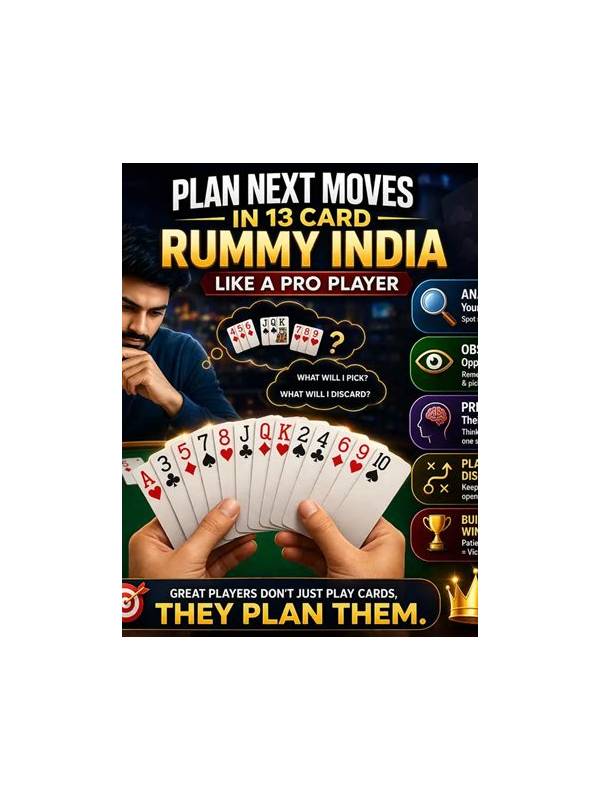
Many rummy hands become confusing because every card seems to suggest a different plan. A pair may become a set, two connected cards may grow into a sequence, and a joker can support several combinations. The answer is not to calculate every possibility equally. It is to separate immediate moves from future ideas.
Start by identifying one or two combinations that are already close to complete. These are your immediate candidates. A suited run with one missing middle card, or a pair that can join a visible matching card, deserves attention because it needs fewer changes. Write the candidate mentally in one short phrase, such as “hearts run” or “low-card set.” Avoid building a long story around it.
Next, list future ideas. A future idea needs at least two helpful events before it becomes useful. For example, two cards of the same suit separated by several ranks may eventually form a sequence, but the plan is still uncertain. Keep it in reserve while you look for cards that improve your immediate candidates. This distinction prevents an attractive possibility from controlling every draw.
On each turn, compare the new card with both lists. If it completes an immediate candidate, the decision is straightforward. If it supports a future idea but leaves the immediate candidate unchanged, ask whether the new option is materially stronger or merely more interesting. Stronger usually means it reduces the number of cards needed, uses fewer high-value points, or creates flexibility in another group.
Discard by removing the weakest idea, not automatically the card with the highest face value. A card that belongs to two realistic plans may be more useful than a low card that belongs to only one distant plan. At the same time, do not protect every flexible card forever. If an idea has survived several turns without improvement, downgrade it and reassess.
This two-list approach creates a calm rhythm: maintain the best immediate route, keep one backup, and release plans that stop earning their space. It also makes post-game review easier because you can ask whether your immediate choice was reasonable at the time, rather than judging it only by the final result.
Try the method in a practice hand by naming the lists after each draw. A star can mark the route closest to completion and a circle can mark the backup. Remove the circle as soon as it becomes stalled. The exercise works even without a live opponent because it trains you to update a plan when evidence changes. With repetition, you spend less time defending an old idea and more time noticing which combination is actually improving. That shift makes difficult turns feel more manageable and gives your discard a clear purpose.